


Ethereum is entering a pivotal moment as its price approaches a critical technical zone, while on-chain activity reaches levels not seen in months. Behind this shift lies the Fusaka upgrade—combined with a rapid influx of new holders joining the ETH ecosystem at an impressive pace.
At the time of writing, ETH is trading around $3,186, just a step away from a potential technical breakout that could redefine its short-term trajectory.
Fusaka Upgrade Fuels Ethereum’s Network Momentum
Implemented on December 3, the Fusaka upgrade addressed one of Ethereum’s long-standing challenges: scalability and Layer-2 costs. By reducing fees and improving overall efficiency, Ethereum has become significantly more user-friendly—especially for DeFi platforms, NFT ecosystems, and payment solutions.
These improvements arrive at a strategic moment, as markets begin positioning for 2026. The result is a more supportive environment for Ethereum’s growth, both in terms of network usage and long-term value.
ETH Holder Count Explodes: A Strong Short-Term Price Signal
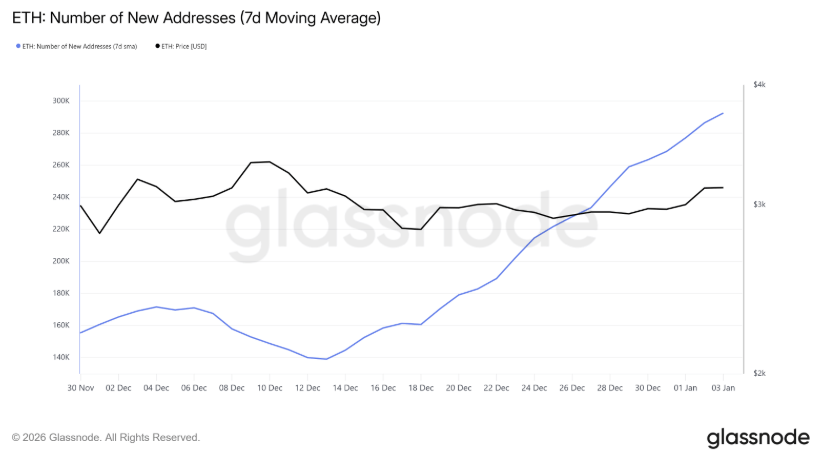
On-chain data reveals that the number of new ETH wallets—addresses interacting with Ethereum for the first time—has jumped by approximately 110% in just three weeks. Currently, Ethereum is adding nearly 292,000 new addresses per day, a clear sign that user interest is returning at scale.
In the short term, this surge in holders provides meaningful support for ETH’s price. As ownership spreads across more wallets, circulating supply becomes more distributed, reducing immediate selling pressure. This dynamic tends to stabilize price action during pullbacks and creates a stronger base for upward moves when buying demand increases.
While not every new wallet represents a long-term investor, the scale and speed of this growth suggest broad participation—not merely isolated speculative activity.
Long-Term Holder Growth Strengthens Ethereum’s Foundation
From a longer-term perspective, a steadily rising holder base is one of Ethereum’s most important structural advantages. Networks with a broad and growing holder distribution tend to exhibit greater decentralization, deeper liquidity, and stronger resilience during market volatility.
More importantly, as ETH is held by a wider audience, demand for real network usage—staking, DeFi participation, and Layer-2 transactions—naturally expands. This creates a positive feedback loop between utility and market value, allowing ETH to grow not just cyclically, but sustainably.
Mid-Term Holders Accidentally Become Price Support
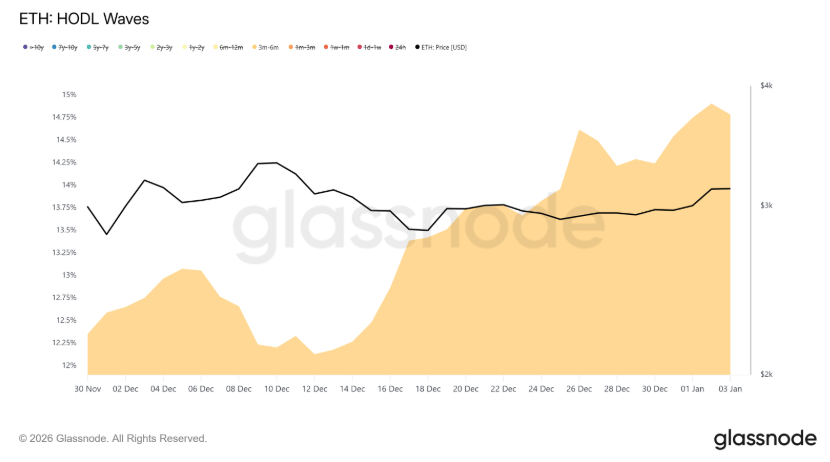
HODL Wave data shows a notable increase in ETH held for 3–6 months, with most of these positions accumulated between July and October 2025.
Early buyers in this range are sitting on profits, while later entrants remain underwater. This has created a “forced holding” dynamic, where many investors prefer to wait for recovery rather than sell at a loss. In the short term, this behavior reduces selling pressure and unintentionally forms a price buffer for ETH.
However, as price approaches the breakeven zone for this group, profit-taking could increase—potentially slowing momentum unless fresh capital enters the market.
ETH Approaches a Critical Breakout Zone
Technically, Ethereum has been trading within a descending wedge since early November—a pattern that often precedes trend expansion. ETH is now testing the upper boundary of this structure.
A confirmed breakout could open the door to $3,287, followed by $3,447 in the near term. A more optimistic scenario places ETH on a path toward $4,061, though this would require sustained and convincing buying pressure.
On the downside, rejection at resistance could send ETH back below $3,000, with the $2,902 support zone coming into focus.
Conclusion
The sharp rise in Ethereum holders following the Fusaka upgrade is delivering tangible benefits in both the short and long term. While increasing holder counts help reduce selling pressure and stabilize price action today, they also reinforce Ethereum’s network fundamentals and long-term resilience.
That said, ETH is clearly at a decisive crossroads. Any meaningful breakout must be supported by fresh capital and genuine market conviction. If on-chain metrics continue to strengthen, Ethereum may be entering a phase of sustainable growth—rather than just another temporary technical rebound.

